RoboKids Explorer
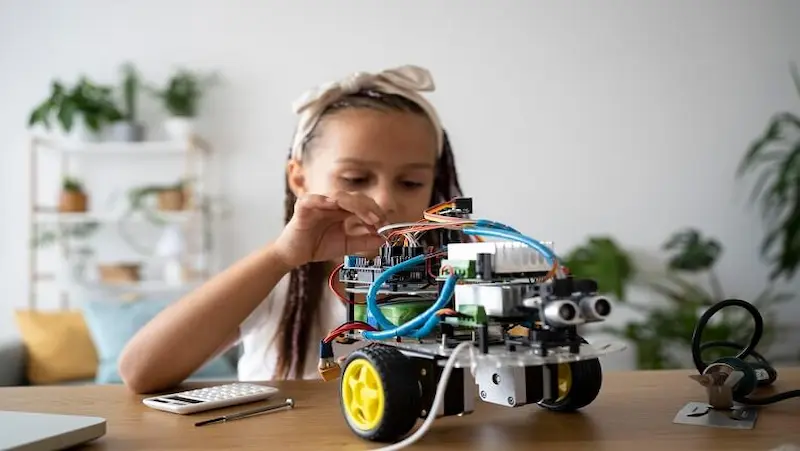
Sensors, motors, and logic using block coding. Build line followers and obstacle bots.
Duration: 2 Years
Back to HomeCourse Syllabus
MODULE 1: Introduction to Robotics & IoT (3 Sessions)
🔹 Topics Covered:- What is a Robot? – Definition, history, and real-world applications.
- Components of a Robot – Sensors, actuators, controllers, power source.
- What is IoT? – Real-world examples (Smart Homes, Smart Cities, etc.)
- Difference between Robotics and IoT
- Applications of IoT and Robotics in various industries.
- Overview of the course and expected outcomes.
Students will gain basic theoretical understanding of Robotics and IoT and how these fields are shaping the modern world.
MODULE 2: Introduction to Arduino & Electronics (6 Sessions)
🔹 Topics Covered:- What is Arduino? Overview of Arduino UNO.
- Setting up Arduino IDE (Installing software, drivers).
- Writing and uploading first sketch (Blink LED).
- Introduction to breadboard, jumper wires, LEDs, resistors.
- Basic electronic concepts: Voltage, current, Ohm’s law.
- Difference between analog and digital pins.
- Reading serial monitor and using Serial.print().
- Circuit diagrams – symbols and reading skills.
- Blink LED
- Fading LED with PWM
- LED sequence patterns (traffic lights)
- Button-controlled LED
Students will be able to write simple Arduino programs and understand the fundamental concepts of electronics.
MODULE 3: Sensors and Inputs (6 Sessions)
🔹 Topics Covered:- Using Push Buttons and Debouncing techniques.
- Reading analog input – Potentiometer.
- Light Dependent Resistor (LDR) – Light sensor.
- Temperature & Humidity Sensor (DHT11) – Interfacing and calibration.
- Ultrasonic Sensor (HC-SR04) – Distance measurement.
- Infrared Sensor – Obstacle detection and line detection.
- Motion Detection with PIR sensor.
- Automatic Night Light with LDR
- Digital Thermometer with DHT11 + LCD
- Distance Meter with Ultrasonic Sensor
- Motion detector alarm using PIR
Students will be able to collect data from the environment using sensors and process them in Arduino.
MODULE 4: Outputs and Actuators (5 Sessions)
🔹 Topics Covered:- Introduction to actuators – Buzzers, Motors, Servos.
- DC Motors and Motor driver (L298N) basics.
- Servo Motors – Position control (0–180 degrees).
- Relay Module – High-voltage control basics.
- LCD Displays (16x2) – I2C vs non-I2C.
- Combining sensor input and actuator output.
- Servo sweep project
- Smart Fan with DHT11 + Motor
- Display temperature on LCD
- Buzzer alarm system
Students will be able to control outputs like motors, servos, buzzers, and displays using Arduino.
MODULE 5: Robot Building & Control (7 Sessions)
🔹 Topics Covered:- Basics of robot motion – Wheels, differential drive.
- Line follower robot – Using IR sensors.
- Obstacle avoidance robot – Using Ultrasonic sensor.
- Bluetooth module (HC-05) – Introduction and AT commands.
- Smartphone-controlled robot – Bluetooth control.
- Speed control using PWM.
- Introduction to chassis and power supply.
- Build and program a line follower robot.
- Obstacle-avoiding robot with buzzer alert.
- Bluetooth-controlled robot using Android phone.
Students will gain experience in building, wiring, and programming working robot models.
MODULE 6: Capstone Projects + Evaluation (5–7 Sessions)
🔹 Project Phase:Students (individually or in teams) will choose a final project from a list or propose their own.
🧪 Example Projects:- Smart Dustbin (ultrasonic + servo)
- Fire detection and alert system